Shooting Choice Information
- A general description of upland management styles
- The style of shooting
- The effects of moorland management on waders (e.g. lapwing, golden plover and curlew)
- The effects of moorland management on birds of prey
- Effects of moorland management on landscape characteristics
- The costs of shooting
A general description of upland management styles
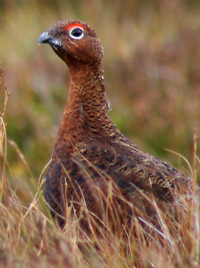 |
| Red grouse |
The Scottish uplands are characterised by extensive heather moorland and Scotland has the largest area of managed heather moorland worldwide. Moorland needs a degree of management to maintain it in favourable condition. Currently, 90% of moorland is privately owned and 30-50% of heather moorland is managed for driven grouse shooting. Grouse shooting starts on 12th August every year. Other activities include land management for deer stalking, farming or for other conservation objectives such as native woodland regeneration.
Grouse shooting in Scotland is estimated to contribute £23.3 million to GDP and supports just over 1000 jobs in rural areas. Employment related to grouse shooting is typically higher on moors focused on driven shooting. The numbers of grouse vary naturally over time and between areas. In order to increase grouse stocks habitat management and legal predator control is carried out.
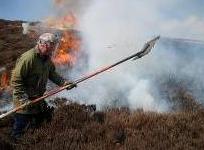 |
| The Muirburn Process |
Heather burning (muirburn) is practised to improve the quality of heather for grouse (which can also benefit deer and sheep). This entails the controlled burning of heather patches, which produces the characteristic patterned landscape associated with grouse moors. In addition, legal control of foxes, stoats and crows is also undertaken to protect grouse stocks; this can have additional benefits for other bird species. Other management practices aimed at increasing grouse numbers involve the control of diseases such as ticks and gut parasites.
The style of shooting
There are two main styles of shooting grouse in Scotland. These are ‘driven’ shooting and ‘walked-up’ shooting. Both are offered commercially and to some extent for the friends and families of the owners. In some areas of moorland no shooting is available.
‘Driven grouse shooting’ aims to provide the opportunity of shooting large numbers of grouse (average 42 brace per day in 2009) and is generally only available when grouse densities are more than 70 birds per 100ha. In this case, grouse are pushed by a line of beaters towards a party of around 8 guns who shoot from a line of grouse butts. In contrast, ’walked-up’ shooting is more common, but not exclusively so, on areas where grouse densities are lower. Parties of around 8 shooters walk over the moor with gun-dogs and shoot the birds they flush (average around 12 brace per day). In some places and in some years, grouse numbers are insufficient for driven shooting, in which case either no shooting or only ‘walked-up’ shooting occurs. A third style, ‘rough shooting’ where a party of 2-3 guns shoot grouse over pointers (around 5 brace per day) accounts for around 10% of shooting activity.
We are interested in what style of shooting for which people would like to see more availability. In the choices below, we ask you to consider the two main options which represent most of the grouse shooting experiences available:
1. Opportunity to take part in ‘driven’ grouse shooting; and
2. Opportunity to carry out ‘walked up’ shooting.
Later on we will ask you to consider the style of shooting you are interested in.
The effects of moorland management on waders (e.g. lapwing, golden plover and curlew)
There is a complex relationship between bird diversity and moorland management styles. Studies have shown that on more intensively managed grouse moors where predator control and burning (which creates a mosaic of heather habitats) are practised there can be around a 15% increase in the breeding success of wading birds such as lapwing, golden plover and curlew. On moors managed for walked-up grouse shooting where there is a lower level of predator control and less varied heather mosaics, densities of waders and species diversity may be lower both due to a lower availability of suitable breeding habitat and due to the loss of eggs and chicks to predation.
We are interested in people's preferences for bird numbers and diversity produced by moorland managed for grouse. In the choices below, we ask you to consider options which vary in terms of the impacts on the population of waders such as lapwing, golden plover and curlew where the impacts are expressed in terms of:
1. No change in current populations on heather moorlands managed for grouse shooting
2. A 15% decline over the next 5 years; and
3. A 15% increase over the next 5 years.
Later we will ask you whether the effect of management on wader populations affects your choice of shooting experience.
The effects of moorland management on birds of prey
Many birds of prey are known to kill red grouse but notably the hen harrier, golden eagle and peregrine falcon. For one of these species, the hen harrier, there is evidence that where harriers breed at high density, they can reduce the numbers of red grouse to such an extent that intensive management becomes uneconomical.
Managed grouse moors represent good quality breeding and hunting habitat for these birds of prey, yet there is clear evidence that these species are often at much lower densities than expected for the type of habitat and prey that is available on moorland managed for driven shooting. This may be because of the perceived risk these birds pose for grouse stocks which leads to some of them being killed by moorland managers, despite the fact that these birds are legally protected across Europe. This is a highly contentious subject and a cause of much conflict between organisations that focus on sporting interests and those that focus on environmental protection.
We are interested in people’s preferences for seeing raptors during their grouse shooting experience. In the choices below we ask you to consider different options for the consequences of moorland management in terms of the effects on birds of prey. The consequences are expressed in terms of:
1. No change in the current population of hen harriers, golden eagles and peregrine falcons on moorlands managed for grouse shooting; and
2. A 20% increase in the populations of these birds, increasing the chance of seeing one in the next 5 years.
In a minute we will ask you whether the chance of you seeing a raptor affects your choice of shooting experience.
Effects of moorland management on landscape characteristics
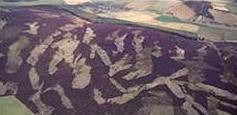 |
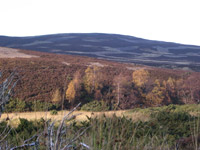
| L1 - Heather dominated muirburn patchwork |
 |
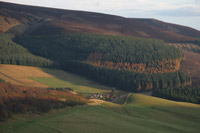
| L2 - Mixture: some muirburn and other vegetation |
 |
| L3 - Mature heather and some woodland |
Burning of heather (muirburn) is a method used by the estate managers to provide a mosaic of heather structure. Young heather is more nutritious and provides quality forage for grouse, while older heather provides shelter for nesting and protection from predators. Where estates are managed for high grouse densities, extensive mosaics of heather patches at different stages of growth form a ‘patchwork’ landscape; often in the form of narrow strips.Burning is also carried out on estates where less intensive walked-up grouse shooting is carried out but to a lesser extent, and patches are often larger and interspersed with areas of longer unmanaged heather. Burning is also less common on estates managed for other purposes (e.g. nature conservation) and there may be areas of woodland.
Depending on how moorland is managed, we can thus think of three possible consequences for the landscape:
1. A moorland landscape dominated by a regular patchwork pattern created by burnt and un-burnt areas(see picture L1);
2. A mixture of patchwork moorland with some areas dominated by different vegetation types and some trees (see picture L2); and
3. No regular patchwork pattern; instead characterised by extensive areas of heather but also larger areas of different vegetation including woodland (see picture L3).
The costs of shooting
The amount that estates charge for shooting is currently related to the number of brace that can be expected to be shot by a party of shooters (grouse shot are counted in brace: one brace = one pair). This reflects the cost of management activities which is in turn related to the intensity with which these management activities are carried out. Fees per brace for driven grouse are often about twice as high as for walked-up shooting (shooters pay a fee of around £100-150 for a brace of driven grouse shot, compared to £70-80 per brace of ‘walked-up’ grouse).Thus a day’s ‘driven’ grouse shooting can cost a lot more than a day’s ‘walked-up’ shooting but the cost is spread between members of the shooting party (usually around 8 persons). This reflects both the higher charge per brace as well as the greater numbers available. Areas with higher densities are likely to have some level of habitat and predator management. However, research across the world shows that shooters care about many factors related to their day’s shooting, so that the expected number of brace shot is certainly not the only determinant of what shooters are willing to pay.
We are interested in how much people are willing to pay for a days grouse shooting based on the price per brace shot. In the choices below we ask you to consider the following prices of different possible shooting options:
1. A shooting option where you would pay £50 per brace;
2. A shooting option where you would pay £75 per brace;
3. A shooting option where you would pay £100 per brace; and
4. A shooting option where you would pay £150 per brace.