Focal Areas
The world of HUNT
National Consultative Groups
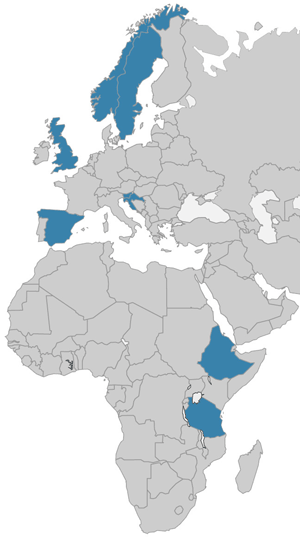
Within each of these countries or regions HUNT will establish National Consultative Groups (NCG's) which will comprise national stakeholders with strong interests and expertise in hunting and biodiversity conservation. Stakeholders will include those with a range of views concerning the value and impacts of hunting from representatives of hunters organizations to government conservation organizations.
Hunting in UK
National surveys of birds, including avian predators are available from the British Trust for Ornithology, Royal Society for the Protection of Birds and via the Raptor Monitoring Groups in Scotland.
Hunting in Scandinavia
Our analyses will focus mainly on a number of representative study areas for which we have access to a range of background data and link these to the national and international institutional framework regulating hunting and biodiversity.
Hunting in Spain
We will consider two study areas with contrasting situations with respect to biodiversity, but where hunting is an equally important activity, and where anomalies in the distribution of some predators have been detected.
Extremadura is a region with a high biodiversity whereas southeastern Castilla-La Mancha is an area where biodiversity is quite impoverished. We will obtain information about management models for the main game species in these areas, from traditional rural hunting performed by local people on community lands to large private game estates, or from large areas with soft or virtually absent game management, to some of the places with the hardest management models in Spain.
This information will be contrasted with available information about biodiversity (national databases available at IREC), complemented when necessary with field surveys. In these same hunting lands we will obtain information from managers about game management techniques used (e.g. predator control, presence of feeding or water points, game crops, etc.) and about socioeconomic aspects of hunting.
Hunting in the Northern Dinarics
Most of the area is subject to hunter harvest under a system where hunting clubs rent hunting rights to hunt on public land. Our focus will be on large mammals, especially brown bears which are hunted as a valuable game species in Croatia, and are controlled under a controversial derogation from the EU’s habitats directive in Slovenia.
Hunting in Ethiopia
Ethiopia is a country exceptionally high in biodiversity (including endemic species), however, wildlife populations throughout the country have been reduced to a fraction of what they were due to a number of causes, including hunting (e.g. Grey’s zebra, African wild ass, Swayne’s hartebeest, mountain nyala, and elephants).
The killing of animals appears to have several root causes, including cultural traditions, subsistence, buffers during famines, and reprisal against repressive government regimes. There are several national parks and controlled hunting areas throughout the country, although the human and financial capacity for protected area management is low.
The state is highly focused on the monetary benefits from controlled hunting areas, particularly concession fees and trophy fees, although there has been little to no research into the market value of either and reinvestment of hunting revenue into conservation or development is minimal or absent.
New management guidelines for limited harvesting are currently being initiated under a new country-wide Protected Areas Systems Plan.
Hunting in Tanzania
The Tanzanian studies will focus on the role and impacts of hunting in the Serengeti Ecosystem of Northern Tanzania.
The Serengeti has been recognized as a Global Wilderness Area by Conservation International and is the world’s last intact migratory ecosystem containing in excess of two million ungulates and the largest and most diverse guild of carnivores in Africa.
The Serengeti is zoned into different categories of protected areas including national parks allowing only eco tourism, game reserves allowing only trophy hunting and community-based wildlife management areas allowing both trophy hunting and subsistence hunting.
Illegal hunting both for subsistence and for commercial sale is widespread throughout the ecosystem. Trophy hunting focuses primarily on buffalo and lion whilst subsistence hunting is concentrated on smaller bodied ungulates such as wildebeest, impala and gazelle.
The indigenous population is ethnically diverse and includes agro-pastoralists, pastoralists and hunter-gatherers.
Tourism revenue and support from international NGO's have resulted in an efficient protected area management infrastructure and some limited community development activities.