Learn more about our main findings and links to the underlying research base:
HUNTs vision document:Visions for sustainable hunting
Insights for policy and practice
Findings from the workpackages (WPs):
- WP1: The cultural meaning of hunting
- WP2: Institutions and governance of hunting
- WP3: The values associated with hunting
- WP4: Hunting, sustainable harvesting and consequences for biodiversity
- WP5: Decision making and conflicts - hunting in a multiple use landscape
Best practice recommendations:
- Social-ecological modelling for sustainable hunting
- Scenario workshops
- Interviewing on sensitive topics
- Participatory multi-criteria decision analysis
- Engaging with stakeholders – Managing expectations
Insights by region
We have summarised some of our main findings from each country into separate booklets to be downloaded here.
- Scottish Research Briefings
- Norwegian Research Briefings
- Swedish Research Briefings
- Spanish Research Briefings
- Croatian/Slovenian Research Briefings
- Ethiopian Research Briefings
- Tanzanian Research Briefings
In memory of Simon Thirgood
6 December 1962 – 30 August 2009
HUNTing for sustainability
Research on the impact of hunting on biodiversity has shown that hunting can be a force for good in conserving biodiversity. There is evidence that hunting can achieve goals for biodiversity because of the conservation focus many hunting systems have.
But where hunting has negative consequences there are strong cultural reasons why this is maintained. Thus there is a need to understand the cultural and institutional frameworks in which hunting operates if policy is to achieve the goal of utilizing hunting to managing our wildlife sustainably.
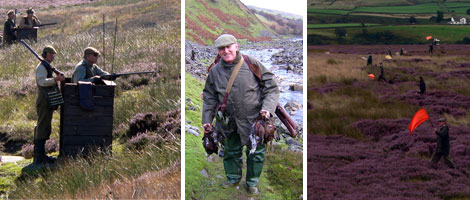
Photo: N. Bunnefeld
Latest publications
- Nuno, A., Bunnefeld, N., Naiman, L., Milner-Gulland, E.J. (in press) A novel approach to assessing the prevalence and drivers of illegal bushmeat hunting in the Serengeti. Conservation Biology. doi: 10.1111/cobi.12124
- Nuno A., Bunnefeld, N., Milner-Gulland, E. J. (2013) Matching observations and reality: using simulation models to improve monitoring under uncertainty in the Serengeti. Journal of Applied Ecology 50(2): 488–498. doi: 10.1111/1365-2664.12051 http://doi: 10.1111/1365-2664.12051
- Díaz-Fernández, S., Arroyo, B., Viñuela, J., Patiño-Pascumal, I., Riera, P. (2013) Market value of restocking and landscape in red-legged partridge hunting: A study based on advertisements. Wildlife Research 40: 336-343 http://www.publish.csiro.au/paper/WR12191.htm
- Díaz-Fernández, S., Arroyo, B., Casas, F., Martínez-Haro, M., Viñuela, J. (2013) Effect of management on wild red-legged partridge abundance. PLOS ONE 8(6) art. no. e66671
- Delibes-Mateos, M., Díaz-Fernández, S., Ferreras, P., Viñuela, J., Arroyo, B. (2013) The role of economic and social factors driving predator control in small-game estates in central Spain. Ecology and Society 18(2): 38 http://www.ecologyandsociety.org/vol18/iss2/art28/